Supercritical CO2 Recompression Brayton Cycle
The Brayton cycle you might already know from gas turbines runs on ordinary air: compress it, add heat, expand it through a turbine, dump the exhaust. Swap the air for carbon dioxide and keep the whole loop above CO2's critical point (7.38 MPa, 31 °C) instead of venting to atmosphere, and you get a closed-loop supercritical CO2 (sCO2) Brayton cycle. Above the critical point, CO2 never boils, it just gets progressively denser as pressure rises, so the compressor inlet sits in a liquid-like, high-density region where compression work is far lower than compressing a normal gas. That single fact is what makes sCO2 cycles compact: smaller compressors, smaller turbines, a fraction of the footprint of an equivalent steam plant, which is a big part of why they keep coming up in Gen IV fission, concentrated solar, and now fusion balance-of-plant studies.
Recompression is the fix for a problem specific to this fluid. A plain regenerative Brayton cycle, one recuperator recovering heat from the turbine exhaust to preheat the compressor discharge, runs into trouble near CO2's critical point. Specific heat spikes there, and it spikes asymmetrically: the cold, dense stream heading into the heater has a much higher cp than the hot, lower-density stream coming off the turbine. A single recuperator sized to avoid a temperature crossover at one end ends up oversized, and full of irreversibility, everywhere else. The standard fix, modeled here, splits the stream after a low-temperature recuperator: part of it goes straight to a second, auxiliary compressor without being cooled first, and only the rest passes through the precooler to the main compressor. That keeps both recuperators' hot and cold streams closer in heat capacity across their whole length, which is what actually fixes the pinch.
Layout follows that recompression architecture: a turbine expanding from the intermediate loop's peak temperature, a reheat pass partway through the expansion to pick up more heat before the low-pressure stage, then a high-temperature recuperator (HTR) and low-temperature recuperator (LTR) in series recovering as much of that exhaust heat as their effectiveness allows, a main compressor and a recompressor splitting the return flow as described above, and a precooler ahead of the main compressor rejecting the rest to the circulating-water/cooling-tower loop.
Both the turbine inlet and the reheat inlet draw straight from the same solar-salt intermediate loop as the Rankine cycle, 565 °C supply from the Secondary HTX, so the sliders here are capped at 560 °C: push either one to a full round 600 °C and you'd be asking the CO2 to leave the heat exchanger hotter than the salt supplying it, which no heat exchanger can do.
Supercritical CO2 Recompression Brayton Cycle Diagram
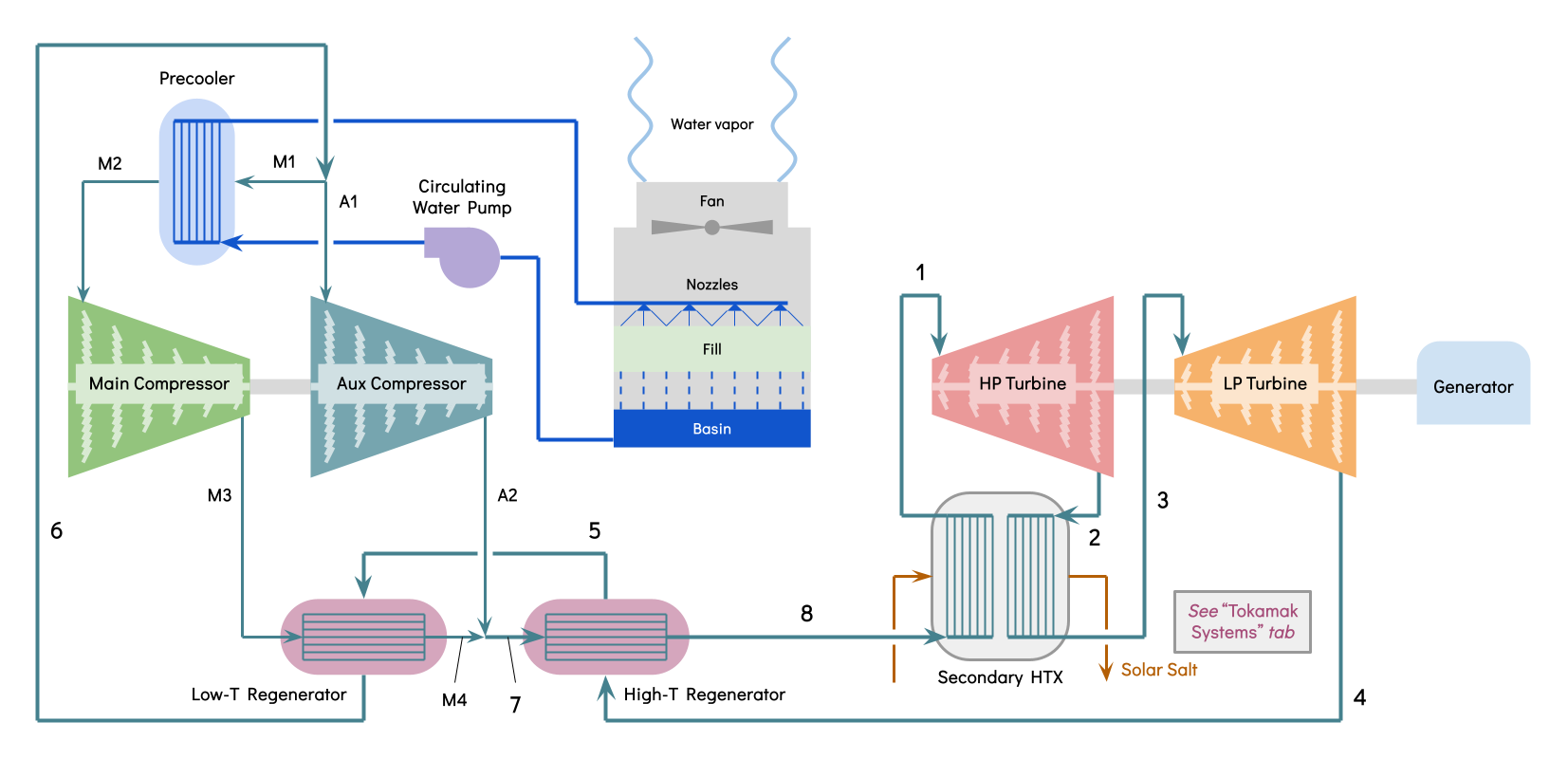
Cycle layout adapted from Colliva, F.; Ciurluini, C.; Iaboni, A.; Centomani, G.V.; Trotta, A.; Giannetti, F. "Analysis of Power Conversion System Options for ARC-like Tokamak Fusion Reactor Balance of Plant." Sustainability 2024, 16, 7480. doi.org/10.3390/su16177480
Recompression sCO2 Brayton Cycle Simulator
Initializing CoolProp WASM…